Common Apache Tomcat Misconfigurations and Remediations

A simple blog post about Apache Tomcat. Still very much used in the industry and I want to learn more about it.

Directory Listing

  1. To enable directory listing, go to <root>/conf/web.xml or <root>/webapps/<webapp>/WEB-INF/web.xml
 1
 2
 3
 4
 5
 6
 7
 8
 9
10
11
12
13
<servlet>
	<servlet-name>default</servlet-name>
	<servlet-class>org.apache.catalina.servlets.DefaultServlet</servlet-class>
	<init-param>
		<param-name>debug</param-name>
		<param-value>0</param-value>
	</init-param>
	<init-param>
		<param-name>listings</param-name>
		<param-value>true</param-value> <!--Change this to true-->
	</init-param>
	<load-on-startup>1</load-on-startup>
</servlet>
  1. To verify this vulnerability, navigate to any directory without index.html. Apache_Tomcat_Dir_Listing.png Not Vulnerable Apache_Tomcat_No_Dir_Listing.png
  2. To remediate,
 1
 2
 3
 4
 5
 6
 7
 8
 9
10
11
12
13
<servlet>
	<servlet-name>default</servlet-name>
	<servlet-class>org.apache.catalina.servlets.DefaultServlet</servlet-class>
	<init-param>
		<param-name>debug</param-name>
		<param-value>0</param-value>
	</init-param>
	<init-param>
		<param-name>listings</param-name>
		<param-value>false</param-value> <!--Ensure this is false-->
	</init-param>
	<load-on-startup>1</load-on-startup>
</servlet>

Default Error Page

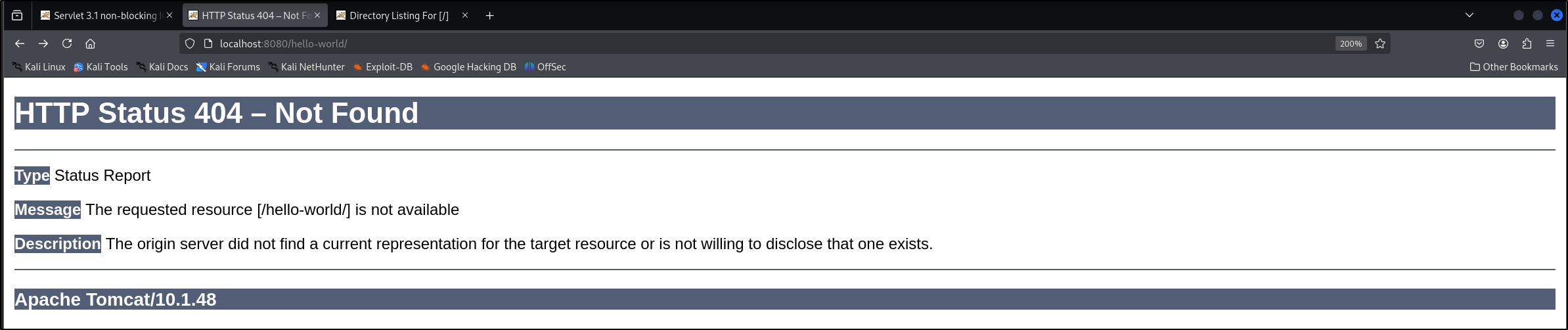
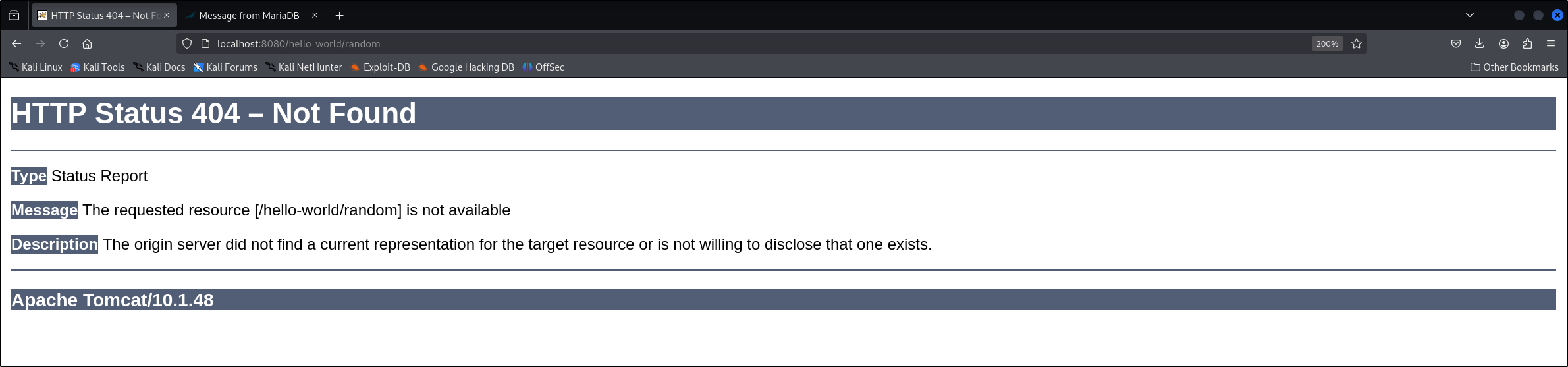
  1. By default, Tomcat serves an error page
  2. To verify, go to a non existent path Tomcat_Default_Error_Page.png
  3. To remediate, use the <error-page> tag. Given this directory structure
 1
 2
 3
 4
 5
 6
 7
 8
 9
10
11
12
13
.
β”œβ”€β”€ error
β”‚Β Β  └── error.html
β”œβ”€β”€ hello.html
└── WEB-INF
    β”œβ”€β”€ classes
    β”‚Β Β  β”œβ”€β”€ CertServlet.class
    β”‚Β Β  β”œβ”€β”€ CertServlet.java
    β”‚Β Β  β”œβ”€β”€ HelloServlet.class
    β”‚Β Β  β”œβ”€β”€ HelloServlet.java
    β”‚Β Β  β”œβ”€β”€ SupermanServlet.class
    β”‚Β Β  └── SupermanServlet.java
    └── web.xml

We can specify a custom error page like this

 1
 2
 3
 4
 5
 6
 7
 8
 9
10
11
12
13
<?xml version="1.0" encoding="ISO-8859-1"?>
<web-app version="3.0"
  xmlns="http://java.sun.com/xml/ns/javaee"
  xmlns:xsi="http://www.w3.org/2001/XMLSchema-instance"
  xsi:schemaLocation="http://java.sun.com/xml/ns/javaee http://java.sun.com/xml/ns/javaee/web-app_3_0.xsd">
	<error-page>
		<exception-type>java.lang.Throwable</exception-type>
		<location>/error/error.html</location>
	</error-page>
	<error-page> <!--Catch all-->
	  <location>/error/error.html</location>
	</error-page>
</web-app>

To verify,

 1
 2
 3
 4
 5
 6
 7
 8
 9
10
11
curl http://localhost:8080/hello-world/WEB-INF/abc/ 
<!DOCTYPE html>
<html>
    <head>
        <title>Error</title>
    </head>
    <body>
        <h1>🚨ERROR🚨</h1>
        <p>Roses are red, Violets are blue, This is an error page, Goodbye to you too.</p>
    </body>
</html> 

Broken Authorization

  1. Example vulnerable configuration
 1
 2
 3
 4
 5
 6
 7
 8
 9
10
<security-constraint>
  <web-resource-collection>
    <web-resource-name>secret</web-resource-name>
    <url-pattern>/secret/*</url-pattern>
    <http-method>GET</http-method>
  </web-resource-collection>
  <auth-constraint>
    <role-name>admin</role-name>
  </auth-constraint>
</security-constraint>
  • This configuration ensures that all GET request will be authenticated and only admin users is authorized to access.
  1. To bypass, we can use any other http methods
1
2
3
4
5
6
7
8
curl http://localhost:8080/hello-world/secret/secret.html -X POST
<!DOCTYPE html>
<html>
    <head><title>Secret Page</title></head>
    <body>
        <h1>My Secret is I have no secrets</h1>
    </body>
</html>  
  • Apparently, older versions of Tomcat allows access with junk HTTP methods too.
  1. To remediate, remove the <http-method> tag
1
2
3
4
5
6
7
8
9
<security-constraint>
  <web-resource-collection>
    <web-resource-name>secret</web-resource-name>
    <url-pattern>/secret/*</url-pattern>
  </web-resource-collection>
  <auth-constraint>
    <role-name>admin</role-name>
  </auth-constraint>
</security-constraint>
  • It will now apply to all methods.

HTTP Enabled

  1. Obviously, it is because no SSL certificate is configured
  2. We can verify it is vulnerable if the scheme is HTTP and not HTTPS.
  3. To remediate, First, create a certificate
1
keytool -genkey -alias tomcat -keyalg RSA -keystore mycertificate.cert

Let’s say Password: admin1234 (Poor password haha) Output:

 1
 2
 3
 4
 5
 6
 7
 8
 9
10
11
12
13
14
15
16
17
18
19
20
Enter keystore password:  
Re-enter new password: 
Enter the distinguished name. Provide a single dot (.) to leave a sub-component empty or press ENTER to use the default value in braces.
What is your first and last name?
  [Unknown]:  superheroes.com
What is the name of your organizational unit?
  [Unknown]:  
What is the name of your organization?
  [Unknown]:  
What is the name of your City or Locality?
  [Unknown]:  
What is the name of your State or Province?
  [Unknown]:  
What is the two-letter country code for this unit?
  [Unknown]:  
Is CN=superheroes.com, OU=Unknown, O=Unknown, L=Unknown, ST=Unknown, C=Unknown correct?
  [no]:  yes

Generating 3,072 bit RSA key pair and self-signed certificate (SHA384withRSA) with a validity of 90 days
        for: CN=superheroes.com, OU=Unknown, O=Unknown, L=Unknown, ST=Unknown, C=Unknown

In <root>/conf/web.xml,

 1
 2
 3
 4
 5
 6
 7
 8
 9
10
<Connector port="8443" protocol="org.apache.coyote.http11.Http11NioProtocol"
		   maxThreads="150" SSLEnabled="true"
		   maxParameterCount="1000"
>
	<UpgradeProtocol className="org.apache.coyote.http2.Http2Protocol" />
	<SSLHostConfig>
		<Certificate certificateKeystoreFile="/home/kali/mycertificate.cert"
					 certificateKeystorePassword="admin1234" type="RSA" />
	</SSLHostConfig>
</Connector>
  • This will just open a HTTPS port on port 8443.
  1. We can verify with a Nmap port scan
1
sudo nmap localhost -p 8443 --script=ssl-cert 

Output:

 1
 2
 3
 4
 5
 6
 7
 8
 9
10
11
12
13
14
15
16
Host is up (0.000079s latency).
Other addresses for localhost (not scanned): ::1

PORT     STATE SERVICE
8443/tcp open  https-alt
| ssl-cert: Subject: commonName=superman/organizationName=Unknown/stateOrProvinceName=Unknown/countryName=Unknown
| Issuer: commonName=superman/organizationName=Unknown/stateOrProvinceName=Unknown/countryName=Unknown
| Public Key type: rsa
| Public Key bits: 3072
| Signature Algorithm: sha384WithRSAEncryption
| Not valid before: 2025-11-08T08:27:53
| Not valid after:  2026-02-06T08:27:53
| MD5:   eb11:2281:1c16:8b54:5ca6:0347:36ea:27c0
|_SHA-1: 7045:713e:da36:eadc:2c39:2703:424c:ebb0:3323:46d2

Nmap done: 1 IP address (1 host up) scanned in 0.18 seconds
  • Of course, it is self-signed, so it is probably a LOW or INFO finding depending on whether it is internal-facing.

Missing Content Security Policy (CSP) Header

  1. To verify,
1
curl http://localhost:8081 -I   

Output:

1
2
3
HTTP/1.1 200 
Content-Type: text/html;charset=UTF-8
Date: Sat, 08 Nov 2025 08:52:41 GMT
  • Missing Content Security Policy Header
  1. Remediation: Look below

How to configure (the most restrictive) CSP

  1. Dependencies:
    1. https://commons.apache.org/codec/download_codec.cgi
1
2
# Download the JAR file and place it in the /lib of your tomcat instance 
cp commons-codec.jar '/home/kali/learning_materials/tomcat and jsp/apache-tomcat-10.1.48/lib'
  1. First, we need to compile this
  1
  2
  3
  4
  5
  6
  7
  8
  9
 10
 11
 12
 13
 14
 15
 16
 17
 18
 19
 20
 21
 22
 23
 24
 25
 26
 27
 28
 29
 30
 31
 32
 33
 34
 35
 36
 37
 38
 39
 40
 41
 42
 43
 44
 45
 46
 47
 48
 49
 50
 51
 52
 53
 54
 55
 56
 57
 58
 59
 60
 61
 62
 63
 64
 65
 66
 67
 68
 69
 70
 71
 72
 73
 74
 75
 76
 77
 78
 79
 80
 81
 82
 83
 84
 85
 86
 87
 88
 89
 90
 91
 92
 93
 94
 95
 96
 97
 98
 99
100
101
102
103
104
105
106
107
108
109
110
111
112
113
114
115
116
117
118
119
120
121
122
123
124
125
126
127
128
129
130
131
132
133
134
135
136
137
138
139
140
141
142
143
144
145
146
147
148
149
150
151
152
153
154
155
156
157
158
159
160
161
162
163
164
165
166
167
168
169
170
171
172
173
174
175
176
177
178
179
180
181
182
183
184
185
186
187
188
189
190
191
192
193
194
195
196
197
198
// webapps/<web-app-name>/WEB-INF/classes/CSPPoliciesApplier.java
import java.io.IOException;
import java.security.MessageDigest;
import java.security.NoSuchAlgorithmException;
import java.security.SecureRandom;
import java.util.ArrayList;
import java.util.List;

/* for Tomcat 9 and below
import javax.servlet.Filter;
import javax.servlet.FilterChain;
import javax.servlet.FilterConfig;
import javax.servlet.ServletException;
import javax.servlet.ServletRequest;
import javax.servlet.ServletResponse;
import javax.servlet.annotation.WebFilter;
import javax.servlet.http.HttpServletRequest;
import javax.servlet.http.HttpServletResponse;
*/
import jakarta.servlet.Filter;
import jakarta.servlet.FilterChain;
import jakarta.servlet.FilterConfig;
import jakarta.servlet.ServletException;
import jakarta.servlet.ServletRequest;
import jakarta.servlet.ServletResponse;
import jakarta.servlet.annotation.WebFilter;
import jakarta.servlet.http.HttpServletRequest;
import jakarta.servlet.http.HttpServletResponse;


import org.apache.commons.codec.binary.Hex;

/**
 * Sample filter implementation to define a set of Content Security Policies.<br/>
 * This implementation has a dependency on Commons Codec API.<br/>
 * This filter set CSP policies using all HTTP headers defined into W3C specification.<br/>
 * <br/>
 * This implementation is oriented to be easily understandable and easily adapted.<br/>
 */
@WebFilter("/*")
public class CSPPoliciesApplier implements Filter {

    /** Configuration member to specify if web app use web fonts */
    public static final boolean APP_USE_WEBFONTS = false;

    /** Configuration member to specify if web app use videos or audios */
    public static final boolean APP_USE_AUDIOS_OR_VIDEOS = false;

    /**
     * Configuration member to specify if filter must add CSP directive used by Mozilla (Firefox)
     */
    public static final boolean INCLUDE_MOZILLA_CSP_DIRECTIVES = false;

    /** Filter configuration */
    @SuppressWarnings("unused")
    private FilterConfig filterConfig = null;

    /** List CSP HTTP Headers */
    private List<String> cspHeaders = new ArrayList<String>();

    /** Collection of CSP polcies that will be applied */
    private String policies = null;

    /** Used for Script Nonce */
    private SecureRandom prng = null;

    /**
     * Used to prepare (one time for all) set of CSP policies that will be applied on each HTTP
     * response.
     *
     * @see javax.servlet.Filter#init(javax.servlet.FilterConfig)
     */
    @Override
    public void init(FilterConfig fConfig) throws ServletException {
// Get filter configuration
        this.filterConfig = fConfig;

// Init secure random
        try {
            this.prng = SecureRandom.getInstance("SHA1PRNG");
        } catch (NoSuchAlgorithmException e) {
            throw new ServletException(e);
        }

// Define list of CSP HTTP Headers
        this.cspHeaders.add("Content-Security-Policy");
        // this.cspHeaders.add("X-Content-Security-Policy");
        // this.cspHeaders.add("X-WebKit-CSP");

// Define CSP policies
// Loading policies for Frame and Sandboxing will be dynamically defined : We need to know if context use Frame
        List<String> cspPolicies = new ArrayList<String>();
        String originLocationRef = "'self'";
        // --Disable default source in order to avoid browser fallback loading using 'default-src'
        // locations
        cspPolicies.add("default-src 'none'");
        // --Define loading policies for Scripts
        // cspPolicies.add("script-src " + originLocationRef + " 'unsafe-inline' 'unsafe-eval'"); <- bad policy!
        cspPolicies.add("script-src " + originLocationRef); // not the best but will do
        if (INCLUDE_MOZILLA_CSP_DIRECTIVES) {
            cspPolicies.add("options inline-script eval-script");
            cspPolicies.add("xhr-src 'self'");
        }
        // --Define loading policies for Plugins
        cspPolicies.add("object-src " + originLocationRef);
        // --Define loading policies for Styles (CSS)
        cspPolicies.add("style-src " + "'unsafe-inline'");
        // --Define loading policies for Images
        cspPolicies.add("img-src " + originLocationRef);
        // --Define loading policies for Form
        cspPolicies.add("form-action " + originLocationRef);
        // --Define loading policies for Audios/Videos
        if (APP_USE_AUDIOS_OR_VIDEOS) {
            cspPolicies.add("media-src " + originLocationRef);
        }
        // --Define loading policies for Fonts
        if (APP_USE_WEBFONTS) {
            cspPolicies.add("font-src " + originLocationRef);
        }
        // --Define loading policies for Connection
        cspPolicies.add("connect-src " + originLocationRef);
        // --Define loading policies for Plugins Types
        // cspPolicies.add("plugin-types application/pdf application/x-shockwave-flash");
        // --Define browser XSS filtering feature running mode
        // cspPolicies.add("reflected-xss block");

        // Target formating
        this.policies = cspPolicies.toString().replaceAll("(\\[|\\])", "").replaceAll(",", ";")
                .trim();
    }

    /**
     * Add CSP policies on each HTTP response.
     *
     * @see javax.servlet.Filter#doFilter(javax.servlet.ServletRequest,
     *      javax.servlet.ServletResponse, javax.servlet.FilterChain)
     */
    @Override
    public void doFilter(ServletRequest request, ServletResponse response, FilterChain fchain)
            throws IOException, ServletException {
        HttpServletRequest httpRequest = ((HttpServletRequest) request);
        HttpServletResponse httpResponse = ((HttpServletResponse) response);

        /* Step 1 : Detect if target resource is a Frame */
        // Customize here according to your context...
        boolean isFrame = false;

        /* Step 2 : Add CSP policies to HTTP response */
        StringBuilder policiesBuffer = new StringBuilder(this.policies);

        // If resource is a frame add Frame/Sandbox CSP policy
        if (isFrame) {
            // Frame + Sandbox : Here sandbox allow nothing, customize sandbox options depending on
            // your app....
            policiesBuffer.append(";").append("frame-src 'self';sandbox");
            if (INCLUDE_MOZILLA_CSP_DIRECTIVES) {
                policiesBuffer.append(";").append("frame-ancestors 'self'");
            }
        }
        /*
        // Add Script Nonce CSP Policy
        // --Generate a random number
        String randomNum = new Integer(this.prng.nextInt()).toString();
        // --Get its digest
        MessageDigest sha;
        try {
            sha = MessageDigest.getInstance("SHA-1");
        } catch (NoSuchAlgorithmException e) {
            throw new ServletException(e);
        }
        
        byte[] digest = sha.digest(randomNum.getBytes());
        // --Encode it into HEXA
        String scriptNonce = Hex.encodeHexString(digest);
        policiesBuffer.append(";").append("script-nonce ").append(scriptNonce);
        // --Made available script nonce in view app layer
        httpRequest.setAttribute("CSP_SCRIPT_NONCE", scriptNonce);
        */

        // Add policies to all HTTP headers
        for (String header : this.cspHeaders) {
            httpResponse.setHeader(header, policiesBuffer.toString());
        }

        /* Step 3 : Let request continue chain filter */
        fchain.doFilter(request, response);
    }

    /**
     * {@inheritDoc}
     *
     * @see javax.servlet.Filter#destroy()
     */
    @Override
    public void destroy() {
        // Not used
    }
}
  1. To compile,
1
javac -cp "$TOMCAT_HOME/lib/servlet-api.jar:$TOMCAT_HOME/lib/commons-codec.jar" webapps/<web-app-name>/WEB-INF/classes/CSPPoliciesApplier.java
  1. Restart the server
  2. To confirm,
1
curl -I http://localhost:8080/<web-app-name>/test1/

Output:

 1
 2
 3
 4
 5
 6
 7
 8
 9
10
11
12
13
14
15
16
17
18
19
HTTP/1.1 200 

Content-Security-Policy: default-src 'none'; script-src 'self'; object-src 'self'; style-src 'unsafe-inline'; img-src 'self'; form-action 'self'; connect-src 'self'

Accept-Ranges: bytes

ETag: W/"299-1762001380542"

Last-Modified: Sat, 01 Nov 2025 12:49:40 GMT

Content-Type: text/html

Content-Length: 299

Date: Sat, 01 Nov 2025 12:50:17 GMT

Keep-Alive: timeout=20

Connection: keep-alive
Licensed under CC BY-NC-SA 4.0