- There are 4 key principles of a good network design:
- Hierarchical: There are different levels in a network and each level is in charge of different things.
- Modularity: Network devices can be grouped into modules and operate as an independent module. A disruption in one module does not affect other modules. Isolation is the keyword.
- Flexibility: The network should be able to handle any upgrades/modifications in the future.
- Resiliency: The network should be able to resist failure in abnormal or malicious events.
- There are two popular hierarchical network design for enterprise/ campus networks.
- 3-tier network design: Classic access, distribution and core tiers.
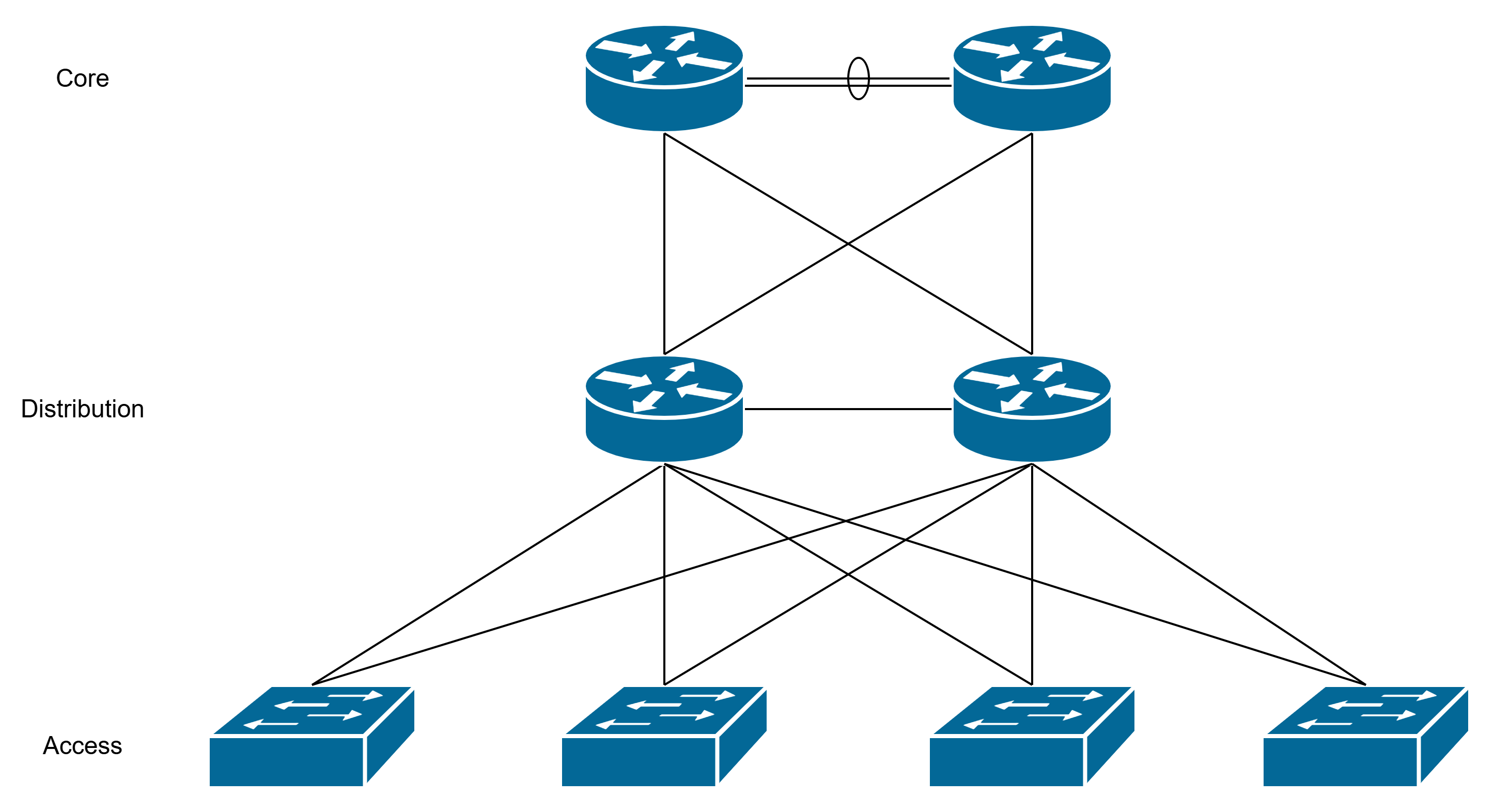
- Collapsed core network design: Access and distribution tiers.
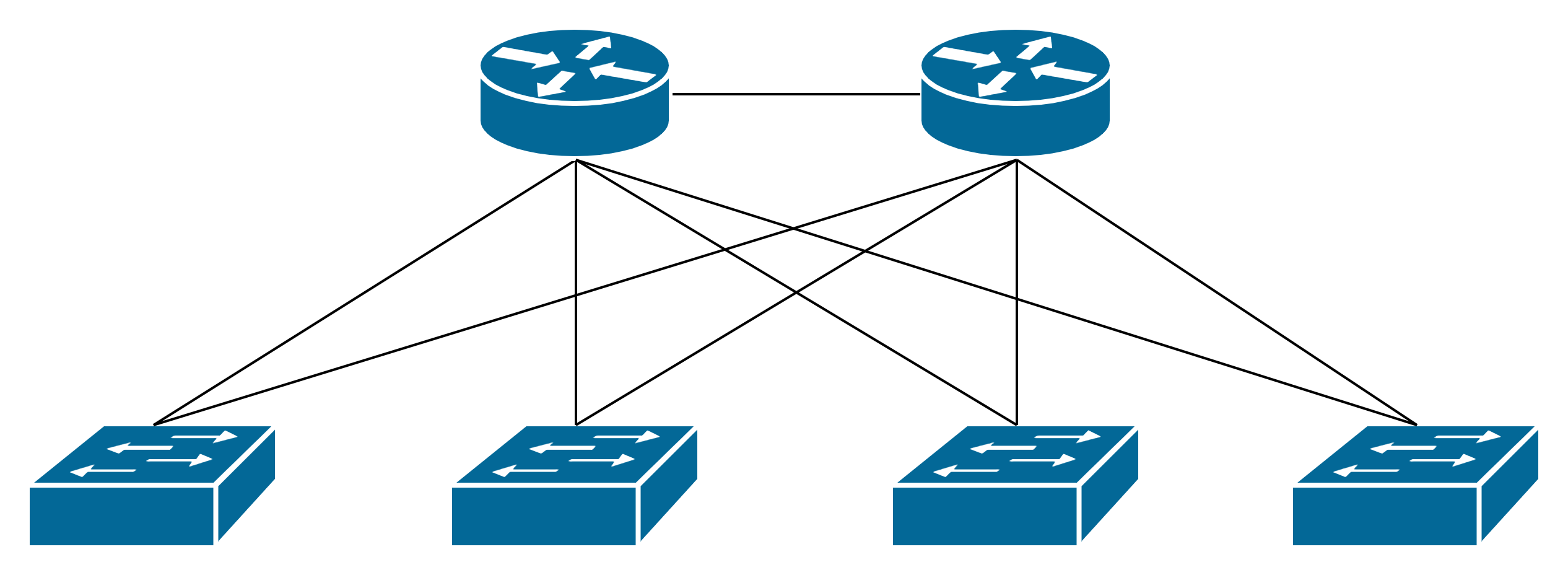
- 3-tier network design: Classic access, distribution and core tiers.
- A brief refresh on the network tiers:
- Access tier: This tier is connected to users. Provides layer 2 connectivity to users.
- Distribution tier: This tier is used to connect access switches together. It also forms the demarcation layer between layer 2 and layer 3 (usually). It is usually the default gateway for a VLAN.
- Core tier: This tier is used to connect multiple access-distribution blocks together. Consider this only when the number of access-distribution blocks is more than 2. Not compulsory actually!
- Connections:
- Access-distribution connections
- There are usually two switches in the distribution tier.
- The access tier can consist of multiple switches. Each switch in the access tier must be connected to all 2 switches in the distribution tier.
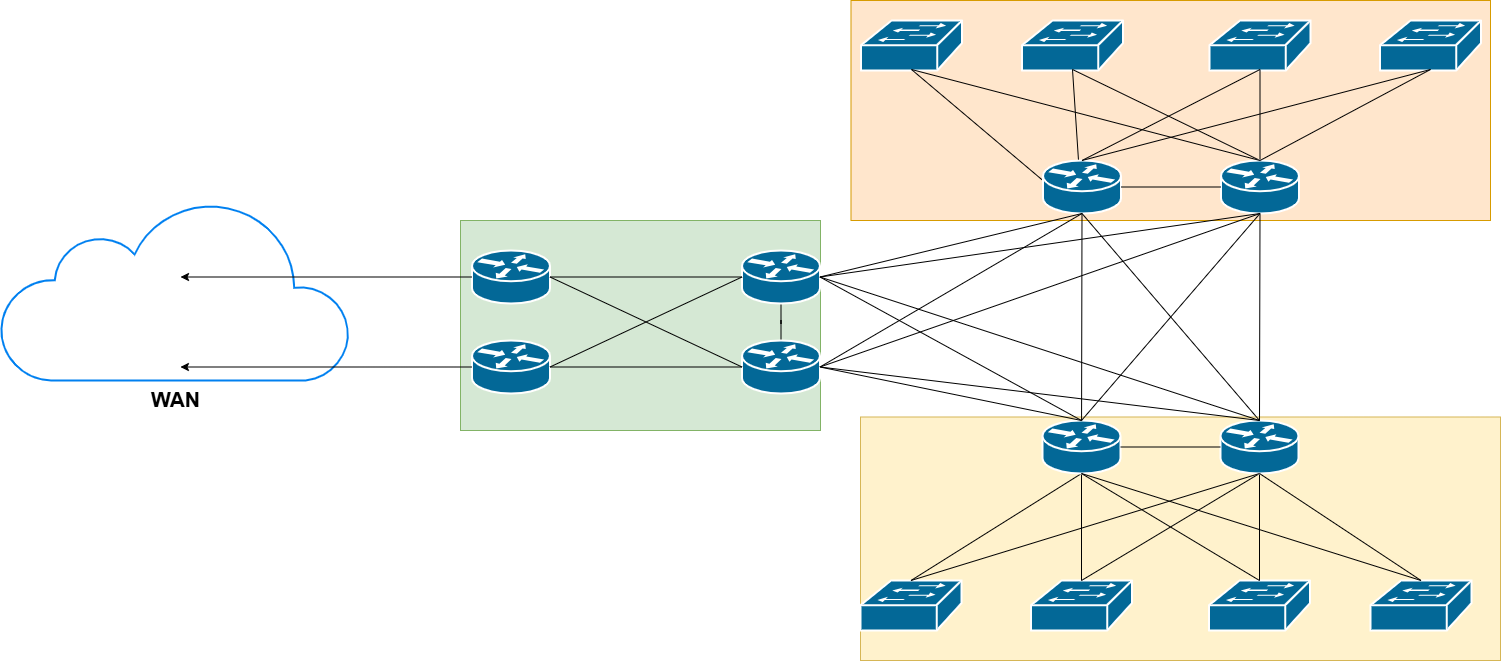
- Distribution-distribution connections
- Distribution tier switches must be connected to each distribution switch in a full mesh topology.
- The number of connections required becomes n*(n-1)/2 where n is the number access-distribution block.
- And remember most routers have less interfaces than switches! You may run out of ports with this design.
- Distribution-core connections:
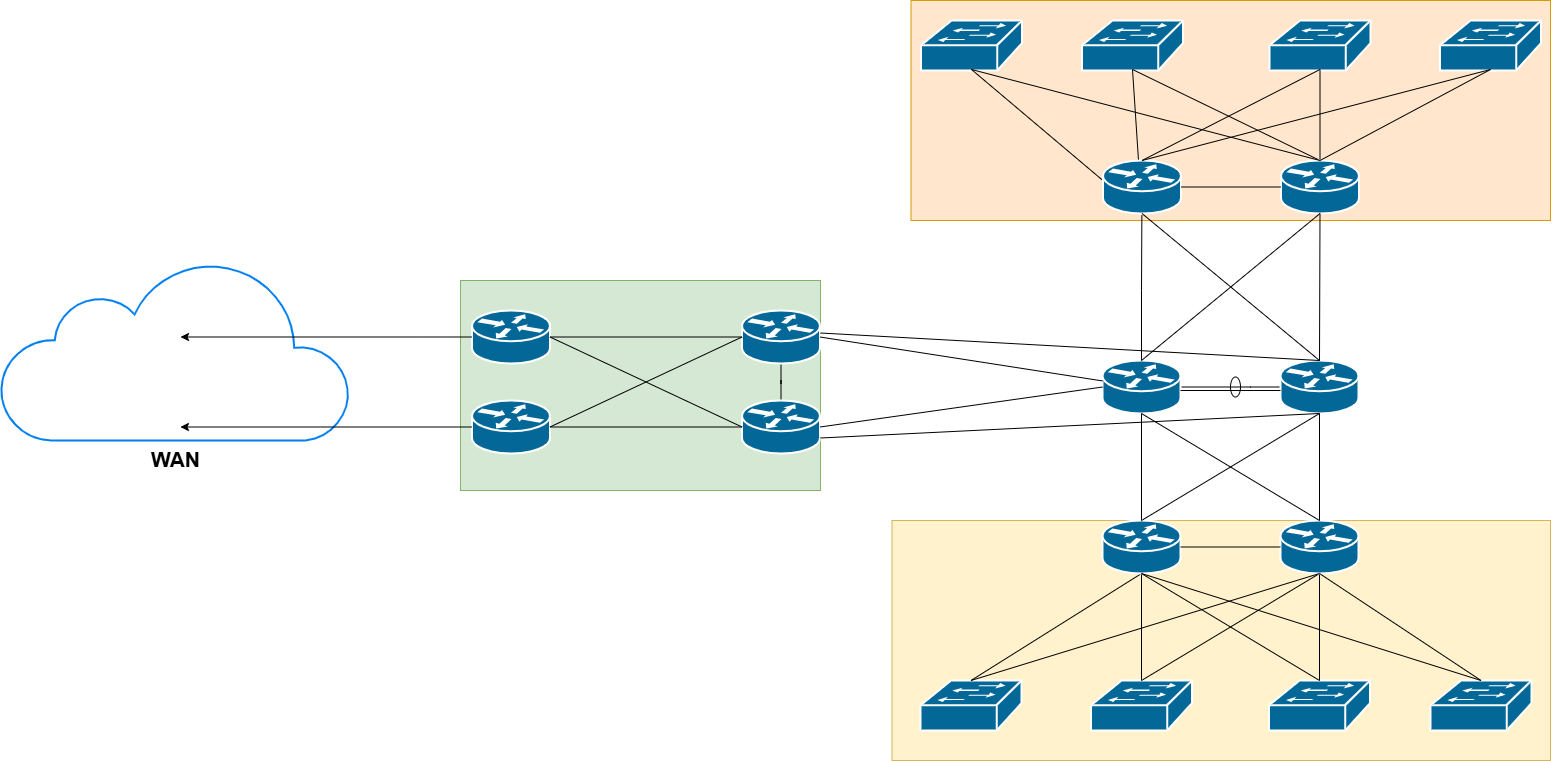
- A core layer can be introduced to reduce the complexity and number of wires required to interconnect different access-distribution block.
- The number of connections required becomes 2n where n is the number access-distribution block. It is a pretty significant reduction in complexity.
- Access-distribution connections
- The basic building block of an enterprise network is an access-distribution block.
- The collapsed core design is an access-distribution block.
- We can have an access-distribution block for a building or a floor.
- Another basic building block of enterprise network is the service block. It is mainly for centralized services for the whole network such as DHCP, DNS servers, WLAN Controller etc.
Deep Dive into Access Tier Designs
- Let’s explore the design of access tier in greater detail.
- Looped design
- Loop-free design
- Routed access
- Virtual Switch
- Software defined access
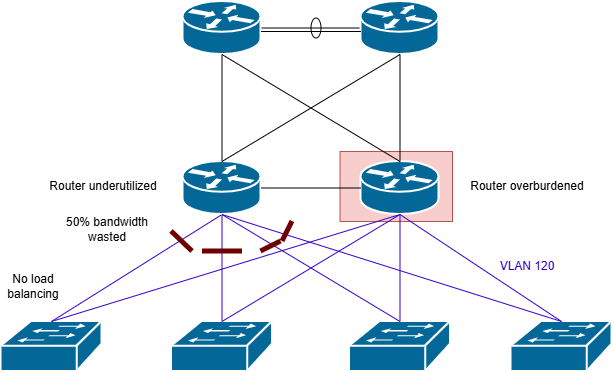
- The looped access tier is the simplest design.
- This design assigns VLAN based purely on function. Eg. there is a VLAN for finance, HR, research etc.
- As such, VLANs will span multiple switches. It causes the network to be vulnerable to layer 2 loops, thus, we need Spanning Tree Protocol to block certain ports to prevent broadcast storms.
- The main disadvantages of this model are the lack of load balancing and delay in stabilizing the network when the network topology changes.
- Some of the disadvantages can be mitigated by using Per VLAN Spanning Tree or Multiple Spanning Tree.
- Loop-free design is an access-tier design that ensures no layer 2 loops are created.
- It is achieved by assigning VLANs per access switch.
- It removes the need of STP, eliminates delay and ensures all bandwidth are used.
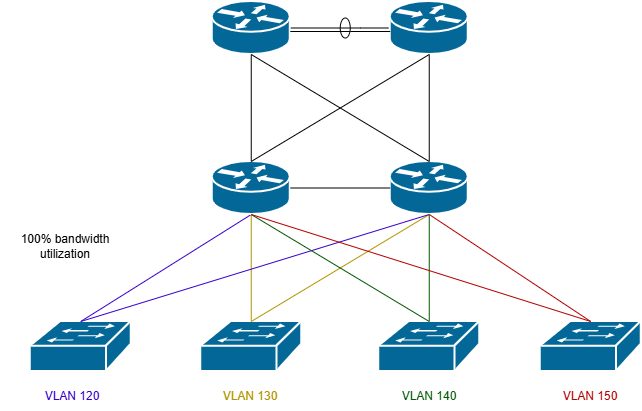
- The loop-free design pattern can co-exist with function-based VLAN assignment.
- Say each switch needs to support 3 VLANs, data, management and voice VLANs. We can assign unique VLANs and subnets to each VLAN.
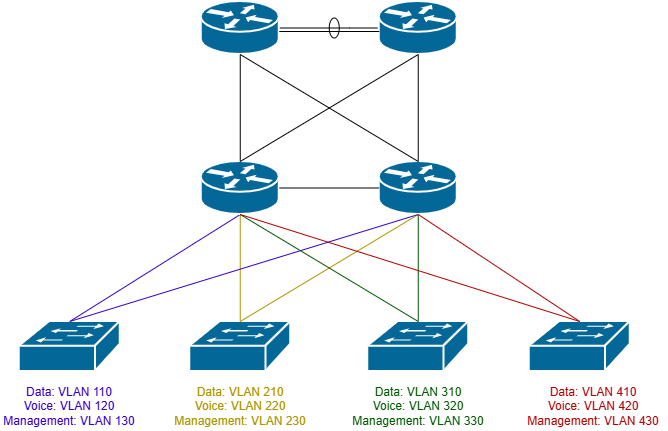
- However, management of VLANs and ACLs becomes cumbersome.
- Say each switch needs to support 3 VLANs, data, management and voice VLANs. We can assign unique VLANs and subnets to each VLAN.
- Routed access is an access tier where layer 3 starts as soon as traffic leaves the switch for the distribution layer.
- It requires the switches to be layer 3 capable. It can also be thought of an extension of the loop-free design.
- It has all the benefits of the loop-free design and enables consistent VLAN numbering across access switches since VLANs does not span switches. However, it should be noted that VLAN 10 on switch level 1 is not in the same broadcast domain as VLAN 10 on switch level 2.
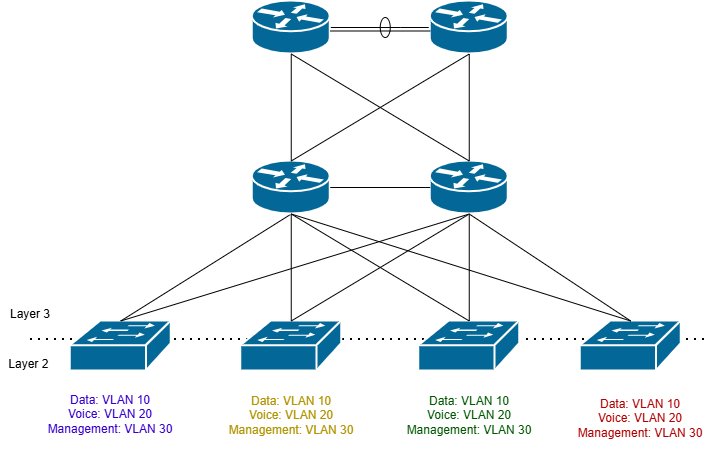
- The IP address range of VLAN 10 switch 1 is also different that that of VLAN 10 switch 2.
- Virtual switch system is an interesting design that combines two physical switches in the distribution layer into a single logical switch. This design allows you to span VLANs across access switches without penalty.
- SD-Access stands for software defined access. It is basically the concept that software will create VLAN configurations and perform VLAN assignments. I will focus less on this one haha.
Oversubscription Ratio
- One important concept in network design is the bottleneck and oversubscription ratio.
- Bottleneck occurs when the rate of input is higher than the rate of output. For example, say you have a switch with 48 1Gbps ports and 4 10Gbps uplink ports. Since 40Gbps < 48 Gbps, a bottleneck is present.
- The gist of oversubscription ratio is that users do not usually use all the bandwidth at the same time. Thus, what level of bottleneck is acceptable?
- Cisco provides soft recommendation for each boundary in the 3-tier architecture. If the usage requirements is higher than expected, then the ratio should be decreased to reduce bottlenecking.
- Oversubscription ratio of access-distribution layer should be up to 20:1 while that of core-distribution layer should be 4:1.
Reference
- https://www.ciscolive.com/c/dam/r/ciscolive/apjc/docs/2025/pdf/BRKENS-1501.pdf
- https://www.ciscolive.com/c/dam/r/ciscolive/emea/docs/2023/pdf/BRKENS-2031.pdf
- https://www.cisco.com/c/en/us/td/docs/solutions/Enterprise/Campus/campover.html
- https://www.cisco.com/c/en/us/td/docs/solutions/CVD/Campus/cisco-campus-lan-wlan-design-guide.html